A nine-system birth chart reads your birth moment through nine independent metaphysical traditions — Western Astrology, Human Design, Ba Zi, Numerology, Feng Shui, Qi Men Dun Jia, Zi Wei Dou Shu, Xuan Kong Da Gua, and Water Formula. This is the canonical guide to what each tradition contributes, the history of integrated readings, and how to choose between integrated and single-system approaches.
Definition: a nine-system birth chart
A nine-system birth chart is an integrated reading of a person's birth moment through nine distinct metaphysical traditions, calculated from a single set of inputs (date, time, and place of birth) and synthesised into a unified picture of personality, life timing, environment, and decision-making.
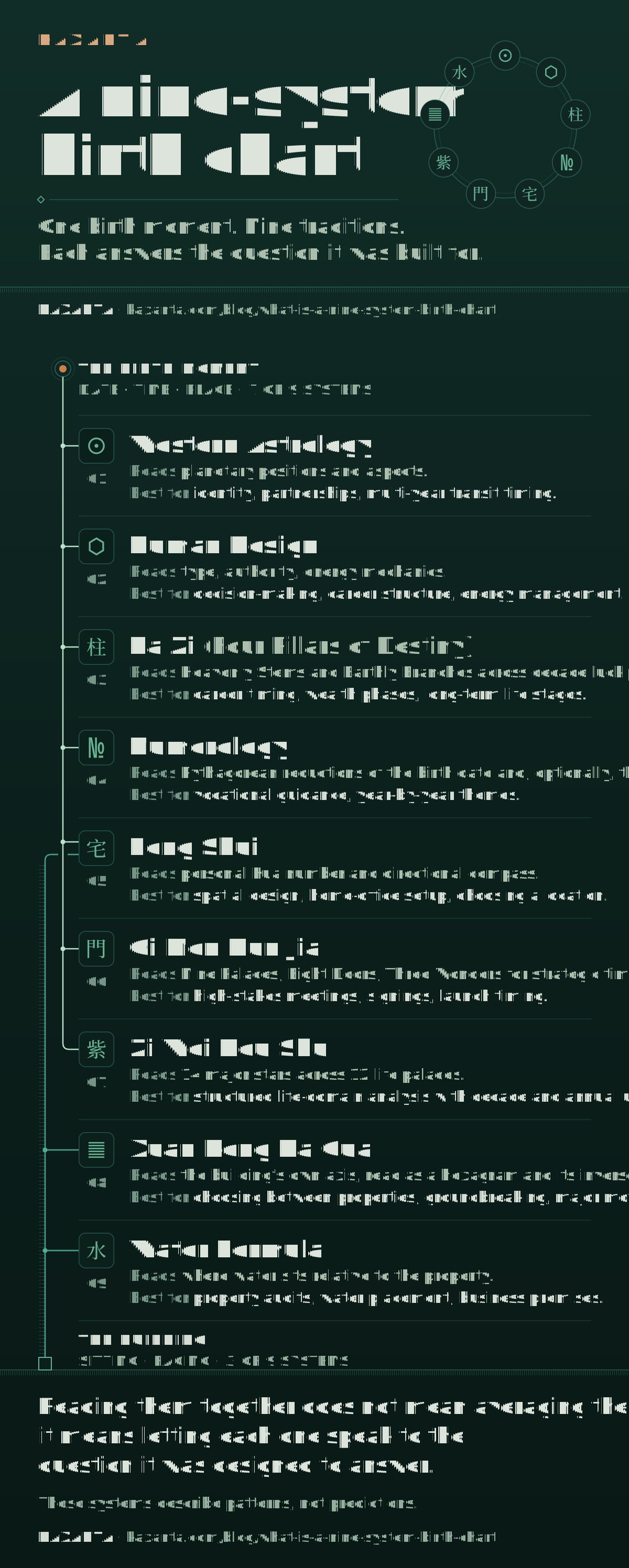
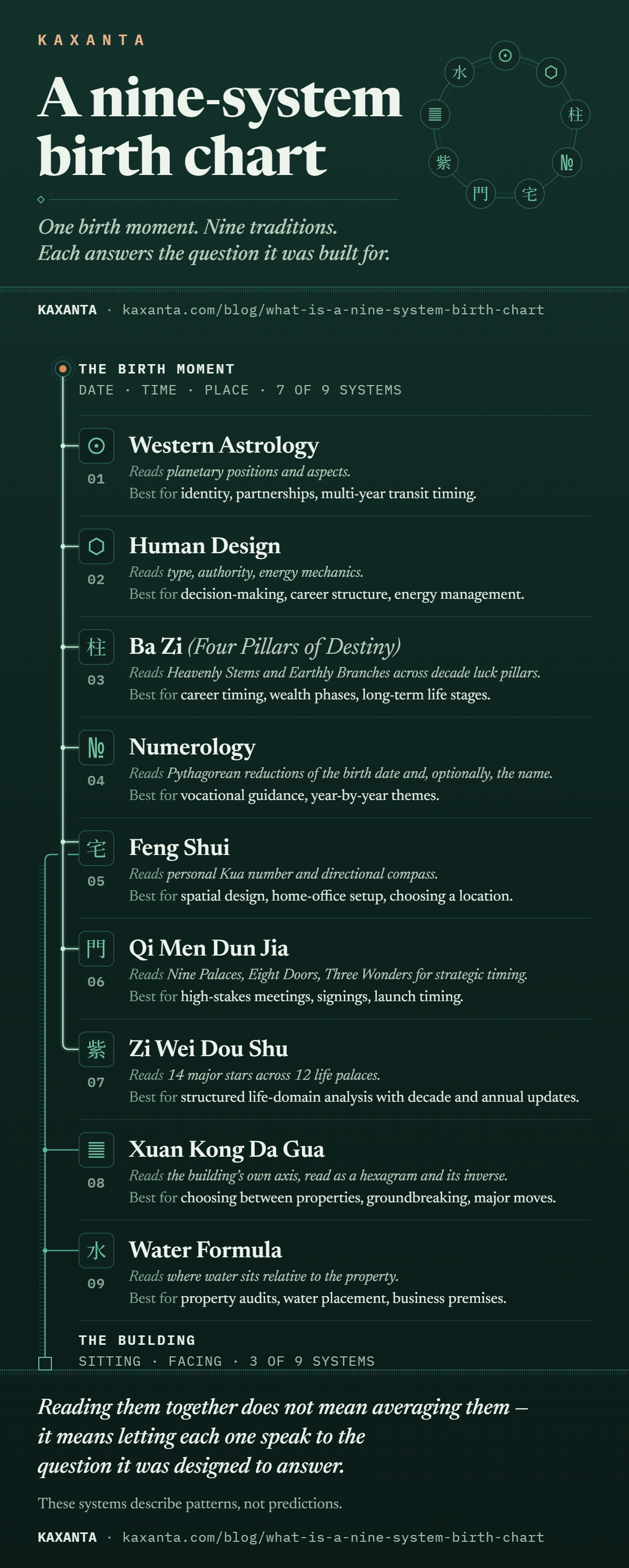
The specific nine systems are: (1) Western Astrology — planetary positions and aspects; (2) Human Design — type, authority, and energy mechanics; (3) Ba Zi (Four Pillars of Destiny) — Heavenly Stems and Earthly Branches across decade luck pillars; (4) Numerology — Pythagorean reductions of the birth date and (optionally) name; (5) Feng Shui — personal Kua number and directional compass; (6) Qi Men Dun Jia — Nine Palaces, Eight Doors, and Three Wonders for strategic timing; (7) Zi Wei Dou Shu — 14 major stars across 12 life palaces; (8) Xuan Kong Da Gua — a building's facing and sitting hexagrams on the 64-hexagram ring, read against the 20-year period; (9) Water Formula (龍門八局, the Dragon Gate Eight Formations) — where water should arrive at a building and where it should leave, read from the palace it sits in.
The nine traditions originated in different cultures (Mediterranean, Chinese, Pythagorean Greek, Vedic-adjacent), span 3,000+ years of development, and were refined for different questions. Reading them together does not mean averaging them — it means letting each one speak to the question it was designed to answer.
What each tradition contributes
Western Astrology answers psychological and relational questions: Who am I when I show up to others? What patterns recur in my closest relationships? What life themes activate when outer planets transit my natal chart? Best for: identity, partnerships, multi-year transit timing.
Human Design answers mechanical questions about energy: How am I designed to make decisions? What is my consistent energy pattern across years? Where do I take in conditioning from others? Best for: career structure, decision-making protocol, energy management.
Ba Zi answers elemental and decade-scale timing: Which elements am I rich or poor in? Which ten-year periods favour which life moves? Best for: career timing, wealth accumulation phases, long-term life-stage planning.
Numerology answers purpose and rhythm questions: What is the underlying number that organises my life? Which personal year am I in right now? Best for: vocational guidance, year-by-year theme awareness.
Feng Shui answers environmental questions: Which compass directions support me? How should I orient sleep, work, and home? Best for: spatial design, home-office setup, location selection.
Qi Men Dun Jia answers tactical timing questions: Which two-hour window is optimal for this specific action? Which direction should I face? Best for: high-stakes meetings, contract signings, launch timing.
Zi Wei Dou Shu answers life-domain questions across 12 palaces: Career, wealth, relationships, children, health, travel, friends, parents, siblings, property, mental health, and overall fortune. Best for: structured life-domain analysis with decade and annual updates.
Xuan Kong Da Gua answers a question about the building itself: which two hexagrams of the 64-hexagram ring does its axis run between, and is that pair timely in the current 20-year period? Best for: choosing between properties, groundbreaking, and major moves where the structure matters more than the occupant.
Water Formula answers water questions specific to a property, read from the palace it sits in: Where should water arrive? Where should it drain away, and where must it not? Best for: property audits, water feature placement, business premises selection.
The value of integrating all nine is not redundancy — it is that no single system can answer all the above questions well. A practitioner specialising only in Western Astrology cannot give meaningful directional advice; one specialising only in Feng Shui cannot describe psychological patterns. The integrated reading uses each tradition for its strength.
History of integrated metaphysics
Integrated multi-system metaphysics is older than the term 'astrology' itself. The earliest documented integrations come from Hellenistic Egypt around the 2nd century BCE, where Greek tropical astrology (developed from Babylonian observational astronomy) was synthesised with Egyptian decanic systems and indigenous calendrical lore.[1] The Hellenistic period produced the first known practitioners who routinely consulted multiple traditions for a single client.
In Imperial China, the Tang Dynasty (618–907 CE) saw the rise of dedicated metaphysics academies that taught Ba Zi, early Feng Shui, and Zi Wei Dou Shu (then in its early form) as a single curriculum. The classical text Yuan Tian Gang (袁天罡), attributed to Tang astrologer Yuan Tiangang, integrates several systems for a unified reading. The Song Dynasty (960–1279) consolidated this with Chen Tuan's formalisation of Zi Wei Dou Shu and Liao Yuxia's elaborations on Feng Shui's San He school.[2]
Western integrated practice declined during the European Enlightenment as astrology lost academic standing, but persisted in esoteric and theosophical circles through the 19th and early 20th centuries. The 20th-century revival is associated with figures like Dane Rudhyar (psychological astrology), Carl Jung (synchronicity as the philosophical underpinning), and Liz Greene (depth-psychology integration).[3]
Human Design emerged in 1987 from Ra Uru Hu's synthesis of Western Astrology, the I Ching, the Kabbalistic Tree of Life, the Hindu chakra system, and quantum physics — itself an explicitly integrated framework.[4] The 21st century has seen accelerating interest in cross-tradition synthesis, partly driven by globalisation (a Western practitioner can now study Ba Zi with a Singaporean master via video) and partly driven by computational capability (calculating nine systems by hand is a multi-day exercise; calculating them by software is instant).
The specific 'nine-system' framing is contemporary, reflecting the stable set of traditions that have substantial English-language scholarly translation and active practitioner communities. The exact composition can vary — some integrated practices include Vedic / Jyotish or Mayan / Tzolkin systems instead of Xuan Kong Da Gua or Water Formula. The unifying principle is the same: more independent traditions cross-validate the patterns one tradition surfaces.
Single-system vs nine-system: when each works better
Use a single system when you have a focused question that one tradition is designed to answer better than the others. Want to understand a relationship dynamic? Western Astrology synastry is the highest-resolution tool. Want to time a business launch to the hour? Qi Men Dun Jia is purpose-built for that question. Want to know whether to take a senior advisory role? Human Design's Authority answers it directly. A specialist consultation in the right tradition often beats a multi-system overview when the question is narrow.
Use a nine-system reading when the question is broad, the stakes are high, or you want to filter for patterns that appear across multiple traditions (which carry more weight than any single observation). Major life transitions — career pivots, relocations, marriage, parenting decisions — typically span timing, environment, identity, and energy simultaneously, and no single tradition addresses all four. Nine-system reading is also more robust when you do not yet know which tradition's frame fits your situation; the integrated reading reveals which system has the most useful answer for your specific question.
A practical rule of thumb: start with nine-system for the big picture, then go single-system to drill into whichever tradition the integrated reading flagged as load-bearing for your current question. Many KAXANTA users follow this exact pattern — the synthesis surfaces the relevant frame, and then the user studies that frame in depth via the system's dedicated learn page.
How nine-system synthesis works in practice
A nine-system reading proceeds in three stages. Stage 1: parallel calculation. All nine charts are calculated simultaneously from your birth data. This is the technical floor — without all nine being calculated correctly, integration is impossible. Modern software (KAXANTA included) does this in seconds; before computational tools, this stage alone took a skilled practitioner several hours per client and was the main bottleneck preventing integrated practice at scale.
Stage 2: convergence detection. With all nine calculated, the next task is identifying where systems agree. If Western Astrology, Ba Zi, and Zi Wei Dou Shu all describe the next 12 months as a period of structural rebuilding, that convergence carries more weight than any single one alone. Convergence is the signal a multi-system reading is uniquely positioned to find. Some integrations also identify divergence (where one system disagrees with the consensus of the others) as a flag for nuance — usually meaning the dissenting system is describing a different time scale or life domain.
Stage 3: synthesis through a single voice. A nine-system reading is only useful if the practitioner (or AI) can deliver the integrated picture in plain language. Reading nine charts independently and then handing them to the client is just nine readings stacked on a desk. The integration value comes from the practitioner explaining "here is what these nine systems together are saying about your career question," with the dissonances and convergences foregrounded. Without this synthesis layer, multi-system metaphysics produces information overload rather than clarity.
KAXANTA automates all three stages: parallel calculation by the engines, convergence detection by the synthesis rules, and the final synthesis voice via the KAXANTA AI assistant. The free tier covers the calculation and a basic blueprint; deeper synthesis questions (timing, decisions, relationships) sit in the paid tiers.
Common questions about nine-system charts
Q: Is a nine-system chart more accurate than a Western birth chart?
A: 'Accuracy' is the wrong frame for any metaphysical system, single or integrated. These traditions describe patterns, not predictions. What integrated reading does is increase convergence — when multiple independent traditions describe the same pattern, the pattern is more likely to be load-bearing for the question you are asking. A single-system reading leaves you vulnerable to coincidence; a nine-system reading filters for cross-tradition signal.
Q: Which of the nine systems is most important?
A: It depends on the question. For psychological / relational questions, Western Astrology and Zi Wei Dou Shu carry more weight. For timing decisions, Ba Zi (long-term) and Qi Men Dun Jia (short-term) lead. For energy-management and decision-protocol questions, Human Design's Authority is foundational. The integrated reading weights the nine systems differently depending on what you are asking about — there is no universal hierarchy.
Q: Do I need to study all nine systems to benefit from a nine-system reading?
A: No. The synthesis layer (whether human or AI) translates the technical findings into plain language. You receive the actionable insight without needing to interpret hexagrams, palaces, or aspects yourself. If you do want to go deeper into one tradition that the reading flagged as load-bearing, dedicated learning resources for each system are widely available.
Q: How is this different from the 'whole chart' approach in Western Astrology alone?
A: A whole-chart Western reading still uses one tradition's frame — psychology, archetype, transit cycles. A nine-system reading uses nine different frames developed by different cultures for different questions. Even a maximally complete Western reading cannot tell you which two-hour window of next Tuesday is optimal for a contract signing — that's a Qi Men Dun Jia question. Even a maximally complete Ba Zi reading cannot tell you the psychological texture of your Saturn return — that's a Western question. The frames are complementary, not redundant.
Q: Are nine systems too many — does it produce information overload?
A: Yes, if the integration stage is missing. Nine charts handed to a client without synthesis is overload. Nine charts integrated into a single coherent reading is the opposite — the right amount of information for high-stakes life questions, organised by which tradition is best suited to which aspect of the answer. The synthesis layer is what makes the difference. KAXANTA is built around this synthesis being automatic rather than requiring multi-hour practitioner consultations.
References
- AstrologyWikipedia
- History of astrologyWikipedia
- Hellenistic astrologyWikipedia
- Four Pillars of DestinyWikipedia
- Human DesignWikipedia
- A History of Western Astrology Volume I: The Ancient WorldBook
- A History of Horoscopic AstrologyBook
- The Definitive Book of Human DesignBook